Brendan Nyhan

  • Heading to Dartmouth

    Tomorrow morning I head north for the panel on blogs at Dartmouth that I mentioned a couple of weeks ago — hope you’ll stop by if you’re in the area:

    “Mass Communication for the Masses: The Power of Weblogs”
    THURSDAY, APRIL 19, 2007
    4:30 PM – 3 Rockefeller Hall

    Panelists will share their thoughts on the power of blogs in creating communities, influencing local and national politics, and the role they think that blogs will play in the 2008 election. Finally, they will discuss the conflict between weblogs and mainstream media.

    PANELISTS

    ANN ALTHOUSE, Professor of Law, University of Wisconsin
    Visit Ann’s blog at http://althouse.blogspot.com/

    LAURA CLAWSON, Mellon Fellow, Sociology Department, Dartmouth College and Contributing Editor, Daily Kos
    Visit Laura’s blog at http://misslaura.dailykos.com/

    BRENDAN NYHAN, Co-founder, Spinsanity and co-author, All the President’s Spin
    Visit Brendan’s blog at http://www.brendan-nyhan.com/

    JOHN HINDERAKER ’71, Partner, Faegre & Benson, LLP
    Visit John’s blog at http://www.powerlineblog.com/

    ROGER SIMON ’64, Founder/CEO, Pajamas Media
    Visit Roger’s blogs at http://rogerlsimon.com/ and at http://pajamasmedia.com/

    JOE MALCHOW, Dartmouth ’08
    Visit Joe’s blog at http://dartblog.com/

    ANDREW SEAL, Dartmouth ’07
    Visit Andrews’s blog at http://thelittlegreenblog.blogspot.com/

    (Note: I’m trying an Amazon Associates feature that auto-links to books when it gets a keyword match. Hence the random link to All the President’s Spin above.)

  • Hillary Clinton: Not so electable in 2008

    I’ve been blogging about Hillary Clinton’s weak general election prospects for a couple of years. But I never expected her to tank this early. Check out these numbers:

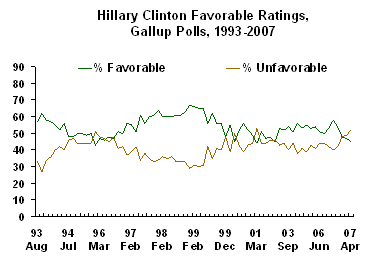
    As the early stage of the race for president heats up, support for Sen. Hillary Clinton appears to be cooling. A majority of Americans now have an unfavorable image of her, a new Gallup poll released today shows. Her current 45% favorable rating is one of the lowest Gallup has measured for her since 1993.

    Her lead as frontrunner for the Democratic nod has narrowed to just 31% to 26% over Sen. Barack Obama. Former Sen. John Edwards comes in at 16% and Al Gore 15%.

    “The recent decline in her image appears to be broad-based, as it is evident among most key subgroups,” Gallup reports.

    In the latest poll, conducted April 13-15, 2007, more Americans say they have an unfavorable (52%) than a favorable view (45%) of Clinton. As recently as February, her favorable rating was 58%.

    Sen. Obama and Sen. Edwards each have favorable ratings of 52% and unfavorable ratings of just 30%.

    Here’s a plot of Hillary’s favorables since 1993 from the Gallup release:

    Pr070418i

    She’s basically as unpopular as she was in the darkest days of the original anti-Hillary backlash even though no one has attacked her yet. The majority of the public has an unfavorable impression of her and the negative ads haven’t even started. Imagine what would happen after 18 months of primary and general election attacks.

    When I worked on a Senate campaign in 2000, we were left for dead when our unfavorables went over 50 percent. How long until Democrats do the same to Hillary?

  • Obama’s strained Virginia Tech metaphor

    Let me join Mickey Kaus and Isaac Chotiner in hating on Barack Obama’s strained attempt to link the massacre at Virginia Tech to other kinds of “violence” such as Don Imus’s racial slur:

    Obama said the killings were “the act of a madman on some level,” and later noted “maybe nothing could have been done to prevent it.”

    Nevertheless, he said, it should cause the nation to reflect on violence in its culture, including the “verbal violence” shown by radio talker Don Imus in his “nappy-headed hos” comment.

    “So much is rooted in our incapacity to recognize ourselves in each other, to not realize we are connected fundamentally as people,” he said.

    The Politico’s Ben Smith strikes the right notes in critiquing the speech on his blog (MP3 audio):

    It’s worth a listen, and it captures what moves a lot of people about Obama, and bothers others: His instinct for abstraction and large themes, and his sense that America’s problems have at their root solutions that have as much to do with hope and process as with any specific course of action.

    Other politicians would — and will — stay with the concrete. They’ll talk about this tragedy, and, soon, gun control.

    But while Obama mourns the slain students, he takes the massacre more as a theme than as a point of discussion.

    “Maybe nothing could have been done to prevent it,” he says toward the end.

    So he moves quickly to the abstract: Violence, and the general place of violence in American life.

    “There’s also another kind of violence that we’re going to have to think about. It’s not necessarily the physical violence, but the violence that we perpetrate on each other in other ways,” he said, and goes on to catalogue other forms of “violence.”

    There’s the “verbal violence” of Imus.

    There’s “the violence of men and women who have worked all their lives and suddenly have the rug pulled out from under them because their job is moved to another country.”

    There’s “the violence of children whose voices are not heard in communities that are ignored.”

    And so, Obama says, “there’s a lot of different forms of violence in our society, and so much of it is rooted in our incapacity to recognize ourselves in each other.”

    Many politicians would avoid, I think, suggesting that outsourcing and mass-murder belong in the same category.

    Indeed. As I wrote before, Obama’s goo-goo appeal has limited reach beyond upscale primary voters. Most people don’t care about his abstract appeals for reform of the political process. Similarly, vague (and incoherent) analogies between a shooting and the “violence” of outsourcing are not going to resonate.

  • Jon Chait on Ari Fleischer’s latest

    Do not miss Jon Chait’s latest takedown of Ari Fleischer, “the world’s most dishonest flack.” It opens beautifully:

    Ari Fleischer has an op-ed in today’s Wall Street Journal. That’s right: It’s the perfect storm of dishonesty–the world’s most dishonest flack meets the world’s most dishonest forum.

    How long will I have to read through the op-ed to find a lie? I’m guessing two sentences. Let’s see … . Nope, I was wrong. I didn’t have to go any further than the headline (“The Taxpaying Minority”). Wow, Fleischer is arguing that only a minority of workers pay taxes? That’s a pretty startling claim.

    Well, no, it turns out, he’s not. Here’s how the op-ed begins:

    If the tax forms you’re filing this year show Uncle Sam entitled to any income tax, you increasingly stand alone. The income tax system is so bad, and increasingly reliant on a shrinking number of Americans to pay the nation’s bills, that 40% of the country’s households — more than 44 million adults — pay no income taxes at all. Not a penny.

    Think of it this way. After dropping off your tax forms at the Post Office, you find 100 people standing on the sidewalk. Forty of them will be excused from paying income taxes thanks to Congress.

    A couple things stand out here. First, Fleischer seems to think that the concept of 40 percent is so difficult that his readers won’t understand it without a real-life illustration. Gee, Ari, you’re throwing around all these fancy numbers, but what does 40 percent really mean? Oh, 40 out of 100. Now I get it.

    The next thing I notice is that this claim is very different from the headline of his column. If 40 percent are paying no taxes, then 60 percent are paying taxes, and thus would not, technically, be considered a “minority.” Rather than tax Fleischer’s brain with fancy mathematical formulas (60 > 40), I’ll break it down for him in simple, homey terms. Think of it this way, Ari: After cashing in on a famous career lying for the Bush administration, you haul several large bags of cash to the bank, where you’re standing in a line of 100 people. Forty of those people are former Bush staffers cashing their ill-gotten rewards from K Street. Therefore 60 of them are not. Sixty is a larger number than 40…

    Of course, the central conceit of Fleischer’s op-ed–that 40 percent of Americans pay no taxes–isn’t true, either…

    And if you missed Chait’s now-classic Fleischer profile from 2002, now’s your chance.

  • Blog dystopia: Matt Stoller v. Power Line

    Here’s an exchange between liberal netroots guru Matt Stoller and Power Line’s Paul Mirengoff that will make reasonable people fear for the future of democracy.

    In a post on the MyDD blog, Stoller asserts that “if you hate democracy, as the right-wing does, then taxes are the price for paying for something you really don’t want”:

    I just paid my taxes, and I have to say, I always take pride when I do so. I don’t like having less money to spend, of course, and the complexity of the process is really upsetting. But I am proud to pay for democracy, and I feel when I do send money to the DC Treasurer and the US Treasury that that is what I am doing. The right-wing likes to pretend as if taxes are a burden instead of the price of democracy. And I suppose, if you hate democracy, as the right-wing does, then taxes are the price for paying for something you really don’t want.

    I don’t spend a lot of time reading the so-called liberal netroots blogs, but if this is the level of discourse on them, things are worse than I thought. Do netroots liberals just take it for granted now that all conservatives hate democracy? Talk about argument by assertion.

    Mirengoff — an attorney who graduated from Stanford Law School (!) — then offered a response that would get him thrown out of Logic 101:

    According to Stoller, “the right-wing likes to pretend as if taxes are a burden instead of the price of democracy.” But while some taxation is the price of democracy (or virtually any other form of government) excessive taxation is, by definition, an undue burden. Excessive taxation is also harmful to our society, unless one believes that there’s no level of taxation that would throw our economy into a downward spiral and/or take too much control of spending decisions out of the hands of citizens.

    Rather than bothering to make an argument that Americans pay too much in taxes, Mirengoff makes the tautological statement that “excessive taxation is, by definition, an undue burden.” Yes, that is what the word “excessive” means. However, asserting an adjective and then defining it is not an argument.

    To sum this exchange up in terms Stoller and Mirengoff might understand:
    (1) Many partisan bloggers appear incapable of constructive debate;
    (2) A bad argument is, by definition, bad.

  • Ezra Klein gives Fox News a bum rap

    Ezra Klein is too smart to be writing posts like this:

    The new Pew Poll on public knowledge of current affairs includes the sadly routine finding that Fox News is doing a remarkable amount of nothing for its viewing audience. Subjected to 35 questions about the news, regular viewers of Fox scored directly in the national average, showing no sign of enhanced knowledge for all the time spent before Brit Hume. Blogs, too, appeared to do little good for their audience, lifting scores by only 2%. The Daily Show and Colbert Report either attract or educated the most informed viewers, along with newspaper websites, PBS, NPR, Limbaugh, and O’Reilly. Maybe none of this should be surprising, though. In the end, Fox News doesn’t exist to inform — it exists to convince. And in that, it’s doing just fine.

    Actually, we can’t infer anything about whether Fox informs its viewers from these data. We have no way of knowing what level of knowledge Fox viewers would have had if they hadn’t watched Fox (all else equal).

    To illustrate the point, imagine trying to measure the effect of Sesame Street on children’s reading or vocabulary. You can’t just compare the reading levels of kids who watched Sesame Street and those that don’t. The reason is that the socioeconomic status of the children (or their parents’ education level, etc.) is likely to be correlated with viewing of Sesame Street. The same principle applies here.

    Klein implicitly acknowledges the possibility that audiences select the media they consume later in the post, writing that “The Daily Show and Colbert Report either attract or educated the most informed viewers” (my italics). I’ll bet on “attract.” While I’m no fan of Fox News, this is an ill-informed criticism at best.

  • Imus firing not about “free speech”

    The claim that the firing of Don Imus has something to do with “free speech” is making me crazy. Let’s review what the First Amendment actually says:

    Congress shall make no law respecting an establishment of religion, or prohibiting the free exercise thereof; or abridging the freedom of speech, or of the press; or the right of the people peaceably to assemble, and to petition the government for a redress of grievances.

    Note that it says “Congress shall make now law … abridging the freedom of speech, or of the press.” It doesn’t say “Private corporations cannot fire people who say offensive things.” The First Amendment is about government regulation of speech. Yet numerous commentators have stated that “free speech” is threatened by Imus’s firing — here’s a sampling:

    Los Angeles Times, 4/14/07

    KABC’s Doug McIntyre said, too, that free speech was imperiled if “a joke — a lame, idiotic, stupid joke” could get Imus fired. If that’s the case for others, he added, “we’re doomed.”

    New York Post editorial, 4/13/07

    CBS did the right thing yesterday in pulling the plug on Don Imus’ radio show, following an outcry over racial remarks he made about the Rutgers women’s basketball team.

    The move came one day after MSNBC’s decision to stop simulcasting Imus’ program.

    Yes, such drastic action raises legitimate free-speech concerns. Imus, after all, is being silenced for words, however repugnant, spoken on what is largely a comedy show. In general, wouldn’t society be better off if people were less sensitive?

    Still, Imus crossed the line.

    Los Angeles Times op-ed by Dana Parsons, 4/12/07

    Not that you asked my opinion, but I’m a free-speech guy and don’t see the point of having it if someone gets fired for exercising it. I would heartily criticize Imus, but probably not fire him.

    Washington Post op-ed by Michael Meyers, 4/11/07

    Defending Don Imus’s on-air racial idiocy is impossible — but defending free speech, even in the form of sick humor, ought to be considered anew in the wake of a storm of protest from censorious activists who are demanding that Imus be fired.

    There is an audience out there that is hungry for the ribald and the offensive. It is an audience that will not go away and cannot be boycotted. Does labeling those listeners and the shock jocks they adore and emulate as racial dunces or “un-American,” and making the shock jocks unemployable (for daring to say what they think), advance the dialogue about racism or sexism? I don’t think so.
    Ours is supposed to be a nation that prides itself on free speech — let a thousand tongues wag, we say, and the truth will be uncovered. But the censors and activists who are so readily offended by idiocy on radio have discovered still another truth: that the First Amendment does not apply to radio shock jocks. And so they want the advertisers and networks to ban the I-Man and toss him off the air. They don’t want to hear from Imus, and they don’t want anybody else to hear him, either. If the censors and pressure groups succeed, what will become of our culture of free speech, especially with such gabbers as Al Sharpton curiously demanding action from the FCC?

    …If we prize freedom, we should let the radio talkers talk. Let them be perfectly understood, and let the pressure groups answer when the talkers veer off reason with their inane hatreds. But we should not allow pressure groups to drive from radio people who say the darndest things and those whose views they don’t like. I say that if you don’t like what you’re hearing, turn the dial. If you want to call in and talk back to the jockass, do so. But we can’t talk back on the radio if the censorship crowd gets its way — if the sound of morning drives is bland conformity with the peculiar and narrow tastes of those who don’t want us to hear what they themselves don’t like.

    The writer is executive director of the New York Civil Rights Coalition and a former assistant national director of the NAACP.

    Tucker, 4/12/07:

    MICHAEL MEYERS: And I’m on MSNBC. And I want to be polite. But let me tell you, I think what the — not only are the advertisers speaking, but I think the executives at MSNBC have engaged in a wanton surrender of the principles of free speech. This is an act of economic cowardice on their part. And I’m shocked that Imus’ fans and his audience have not — have not spoken up.

    Anderson Cooper 360 Degrees, 4/11/07

    COOPER: John Fund, is this a free speech issue, the Don Imus situation?

    FUND: In part, yes. I think Imus should have been reprimanded but I think having fired him, I think you’re setting up a lot of people like Al Sharpton and Jesse Jackson to call for a lot of other people fired perhaps for less incendiary comments in the future.

    You can argue that Imus’s firing will have a chilling effect on public debate about race. But it has nothing to do with “free speech” as such.

  • Tucker Carlson’s new game show

    What’s going on with Tucker Carlson?

    The conservative pundit, who was nice enough to blurb All the President’s Spin, is following up his appearance on “Dancing with the Stars” by hosting a game show:

    Conservative pundit-turned-MSNBC anchor Tucker Carlson is launching yet another new career: gameshow host.

    Carlson has been tapped to host “Do You Trust Me?,” the quizzer format Phil Gurin (“The Weakest Link”) is piloting for CBS (Daily Variety, March 14). Format revolves around strangers forced to put their trust in one another.

    …While it may seem unusual for a political commentator to take a stab at a gameshow, the move is not unprecedented. Former Richard Nixon speechwriter Ben Stein segued from politics to showbiz, first as an actor and then as host of Comedy Central’s “Win Ben Stein’s Money.”

    Carlson has slowly been inching away from his political roots. After CNN decided to end the Carlson co-hosted “Crossfire,” he jumped to MSNBC, where he’s been offering up a less politically focused broadcast.

    And last year, Carlson landed a spot on ABC’s “Dancing With the Stars.” He was eliminated in the first round.

    The show actually has some political implications, however — it’s based on the classic prisoner’s dilemma game, which is widely used in political science and economics:

    [Carlson’s show has] been described as a “prisoner’s dilemma” kind of game show — you know, like when two people are arrested for a crime, put in separate rooms, and detectives try to get each to rat on the other?

    During test runs a few weeks back, the show involved two strangers who have to work together to try to win a big pot of money by turning over tiles with dollar amounts on them. Each also has the opportunity to steal the money from the other. But if both opt to steal in a round of play, they’re out of luck.

    Meanwhile, in the studio audience, people who know the contestants reveal information about the players to other audience members, viewers at home — and the other player.

    Social scientists do a lot of prisoner’s dilemma-type experiments in the lab, but the stakes are usually low. It’ll be interesting to see what happens when a lot of money is on the line. I’m sure Steve Levitt (who wrote a paper about discrimination on “The Weakest Link”) will be watching closely…

  • Travel day

    Just got in to Chicago for the annual conference of the Midwest Political Science Association

  • Another Dateline Hollywood story reported as fact

    How bad is the media at fact-checking? For the third time, an obviously false story from the satirical entertainment news website Dateline Hollywood, which my friend Ben Fritz co-edits, was picked up in the mainstream press.

    First, a Los Angeles Times op-ed claimed the Reverend Jerry Falwell had blamed Ellen DeGeneres hosting the Emmy Awards for Hurricane Katrina and 9/11. Then the Baltimore CBS affiliate reported that Michael Richards had appeared in blackface at a roast for Whoopi Goldberg. Both were based on DH articles.

    The latest offender is the British tabloid The Sun, which picked up on an item claiming Tori Spelling had cast her newborn son in a TV series she was producing. Here’s the report:

    Tori pushes her newborn to act

    By NADIA MENDOZA
    April 10, 2007

    BEVERLY HILLS 90210 star Tori Spelling may soon have to compete for roles – with a one month old baby!

    Her newborn Liam Aaron (son to Dean McDermott), has landed a role in a new soap opera InnSanity.

    But as mummy is producing the show, hopefully there’s no jealousy.

    Tori told Dateline Hollywood: “My son got this role on his own merits. His talent is just as genuine as mine”.

    The show centres around a bed and breakfast and Liam will play Trip, the mysterious infant son of B&B owners Rebecca and Dylan.

    Because of his innocence, many guests share their dark secrets with him… But Liam has a dark secret of his own.

    According to casting director Anna McGarrah: “Liam was the first actor to audition for the role of Trip and he nailed the role so perfectly that there was no point in considering other actors.”

    “The other producers and I were shocked to find out he was Tori’s son, as he auditioned under a fake name.”