Brendan Nyhan

  • Myths about redistricting

    Kevin Drum makes a point about the overstated effects of redistricting that I’ve been meaning to address:

    Is gerrymandering responsible for the fact that it’s virtually impossible nowadays to defeat an incumbent in the House of Representatives? Reporters and pundits seem to accept this without question, but academic research suggests otherwise. For example, Alan Abramowitz, an Emory political science professor who’s studied the decline in competitive seats, recently published a paper concluding that redistricting has had “little to do with the recent decline in competition in House elections. Other developments, such as the growing financial advantage of incumbents and increasing partisanship in the electorate, appear to be more responsible.” He figures that only 12% of the decline in marginal districts has been a result of redistricting.

    The idea that redistricting is responsible for non-competitive House races is pervasive. For instance, Juliet Eilperin is a national reporter for the Washington Post who frequently makes this argument. In last month’s Atlantic, she writes that “Thanks to today’s expertly drawn congressional districts, most lawmakers represent seats that are either overwhelmingly Republican or overwhelmingly Democratic.” She’s made similar claims in her book, the Boston Globe and on NPR’s “Fresh Air”.

    However, as Drum notes, the evidence for this claim is weak. In addition to the Abramowitz finding, John N. Friedman and Richard T. Holden of Harvard have released a working paper suggesting that redistricting has actually reduced incumbent re-election rates (see their New Republic Online article about it). There are many factors contributing to the increase in incumbent security; redistricting is at most a small component of the change.

    One problem is more basic — when people tend to live near other people with similar political views, it creates safe districts. You can’t draw many competitive House districts in rural Texas or New York City. Bruce Reed, the DLC official who blogs on Slate, doesn’t seem to understand this:

    Yet even after poring over this week’s bleak poll numbers, Karl Rove isn’t completely crazy to imagine his party holding onto the House in November. Democrats aren’t likely to win the popular vote by seven points, let alone 17. But what’s really keeping Rove’s dark hopes alive is the Safehouse that Jack and Tom Built—the firewall of safe districts that could enable the Republican party to survive what would otherwise be a China-syndrome political meltdown.

    If congressional districts were truly representative, a party that won a seven-point victory in the popular vote would walk away with a 7 percent edge in the 435-member House of Representatives, or roughly a 30-seat majority. For Democrats, that would represent a pickup of around 45 seats…

    Rigged districts defeat the very reason we have a House of Representatives in the first place. The founders wanted one chamber that would be held accountable to the popular will every two years. When the Electoral College is wrong, at least it’s a wrong the framers intended.

    What Reed is talking about is a system of proportional representation in which legislative seats are allocated in proportion to each party’s national vote. That’s decidedly not what the Founders had in mind. Given that people distribute themselves unequally across the country, our single-member districts will inevitably fall short of the “ideal” proportional representation outcome regardless of whether gerrymandering has taken place.

  • Power Line suggests Jimmy Carter is a traitor

    In a post today, Power Line’s Paul Mirengoff suggests that Jimmy Carter, the 39th president of the United States and a former naval officer, is a traitor:

    Ted Turner said the other day that he had trouble making up his mind which side he supports in the war on terror. If Turner has struggled with this, one can only imagine how fellow Georgian, Jimmy Carter, views the matter. One also wonders whose side, if any, Carter was on when, on behalf of President Clinton, he negotiated the “agreed framework” which paved the way for North Korea to go nuclear.

    This kind of treason-mongering is repulsive. And remember, Power Line was Time’s 2004 blog of the year!

    Update 10/12 6:45 AM: Commenter Lettuce points out that Mirengoff misrepresents Turner’s comment as well. As Media Matters notes, Turner was actually speaking about the war in Iraq, not the war in terror. Here is the full statement, which came in response to a question about “other people have been, when they’ve criticized the Iraq war, criticized the U.S. government conduct …their patriotism has been questioned”:

    Well, I don’t like to see — you know, there are a lot of things about this war that disturb me. And one of them is the attitude that was well-expressed by our president. He said it very clearly. He said, “Either you’re with us or you’re against us.”

    And I had a problem with that, because I really hadn’t made my mind up yet.

    You know, what if you haven’t made your mind up? You know, what if you’re thinking about it, doing some studying, and doing some reading? Because it’s an important decision to go to war, whether or not to go to war.

    I mean, “You’re either with us or against us” — that’s pretty black and white. And just because you disagree with me about it doesn’t mean you’re not a patriot, as far as I’m concerned.

    (The statement is somewhat confusing, because the comment by President Bush that Turner referenced came long before the war in Iraq.)

  • Pete Hoekstra still looking for WMD

    Apparently unembarassed by the spectacle of Vice President Cheney’s aides sending coordinates of alleged weapons caches directly to David Kay, Rep. Pete Hoekstra is still looking for the non-existent Iraqi WMDs that have become his white whale:

    House Intelligence Committee chairman Rep. Peter Hoekstra is still pressing U.S. intelligence agencies to look for possible weapons of mass destruction in Iraq — even though intelligence officials say further work is unlikely to reveal anything new about Saddam’s WMD programs.

    In recent weeks, congressional and intelligence sources say, Hoekstra has prodded the Defense Intelligence Agency and the National Geospatial-Intelligence Agency to follow up on new leads about possible WMD sites in the country. One intelligence official, who asked not to be identified because of political sensitivities, said the agencies have devoted “hundreds of man hours” to the hunt.

  • Carlos Gutierrez has a lot of free time

    What do you do when you’re a powerless cabinet secretary in a highly centralized administration? Go to book fairs!

    Here’s something you don’t see every day: a prominent cabinet member standing in line for an hour outside to collect an author’s autograph. But that’s exactly what Commerce Secretary Carlos Gutierrez did this month during the National Book Festival on the Mall. His target was historian Doris Kearns Goodwin, who, when she looked up after penning her John Hancock, asked for Gutierrez’s in return. The secretary tells us: “Attending the National Book Festival was a wonderful way to spend a Saturday afternoon in Washington. It was great to be among book lovers, families, and great authors, and I’m already looking forward to next year’s festival.”

    That’s great, but what about, uh, trying to promote the nation’s commerce? Just asking…

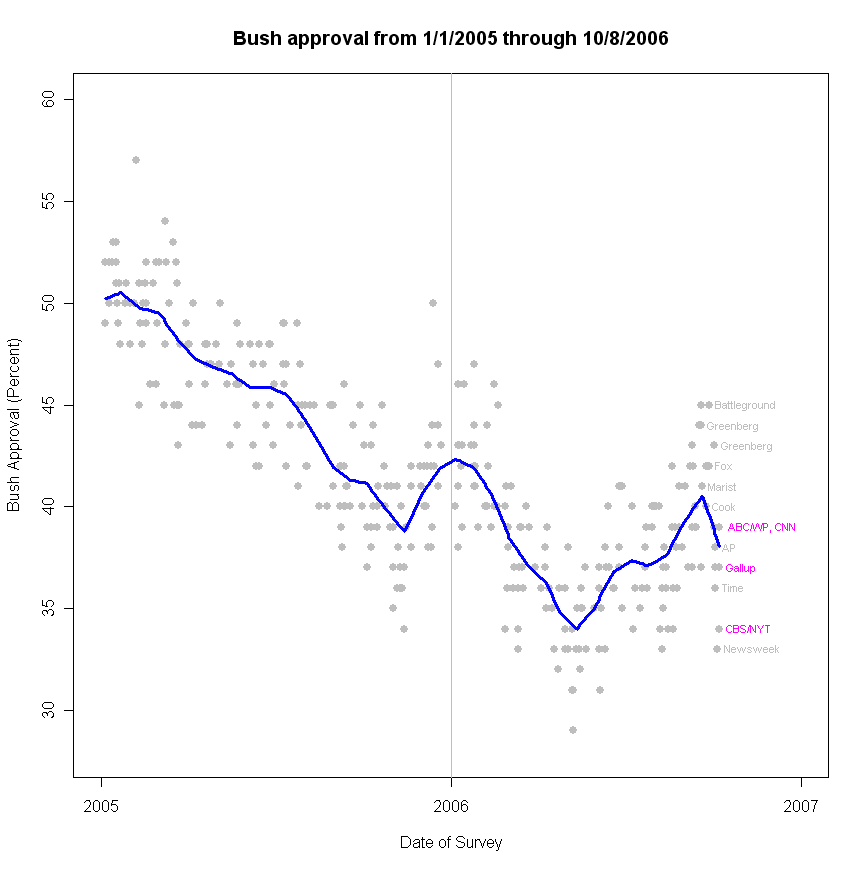
  • Bush ratings not lowest ever

    Dan Froomkin makes a puzzling claim today, writing that “President Bush’s approval ratings appear to be dropping to their lowest levels ever.”

    But a quick look at Charles Franklin’s running tabulation of all presidential approval polls on Political Arithmetik shows that this is not the case, though the trend has turned sharply downward:

    Currentbushapproval20061008

  • Bush vs. his economists IV

    Via Brad DeLong, here’s important news that was ignored by the national press. In an interview with the Washington Times last week, Council of Economic Advisers chair Ed Lazear and Office of Management and Budget director Rob Portman admitted that President Bush’s tax cuts have reduced federal revenue:

    In an interview with editors and reporters at The Washington Times, Mr. Portman and Council of Economic Advisers Chairman Ed Lazear made a pitch for extending the personal and investment tax cuts, which they believe spurred growth in the economy and stock market.

    But they conceded that the tax cuts have not prompted more people to get work and contribute to the economy, while they cut deeply into government revenue and contributed to record budget deficits that have not shown much improvement until recently.

    “We do not say the tax cuts pay for themselves,” said Mr. Lazear. “The point is that they created a positive environment for income growth” while helping make the 2001 recession shallower than it otherwise would have been.

    In making this statement, Lazear joins many other administration economists in contradicting frequent White House claims that the tax cuts have increased revenue (see previous installments in the “Bush vs. his economists” series — part 1, part 2, and part 3). Let’s review the record.

    Since taking office in 2001, President Bush and numerous officials in his administration have repeatedly implied that tax cuts increase revenue and reduce the deficit — here is just a sampling of those statements:

    President Bush, 11/13/02: “Well, we have a deficit because tax revenues are down. Make no mistake about it, the tax relief package that we passed — that should be permanent, by the way — has helped the economy, and that the deficit would have been bigger without the tax relief package.”

    President Bush, 1/7/03: “This growth and jobs package is essential in the short run; it’s an immediate boost to the economy. And these proposals will help stimulate investment and put more people back to work, is what we want to have happen. They are essential for the long run, as well — to lay the groundwork for future growth and future prosperity. That growth will bring the added benefit of higher revenues for the government — revenues that will keep tax rates low, while fulfilling key obligations and protecting programs such as Medicare and Social Security.”

    Press Secretary Ari Fleischer, 1/8/03: “The entire [tax cut] package the President does believe will lead to growth, which will over time grow the economy, create additional revenues for the federal government and pay for itself.”

    Vice President Cheney, 1/30/03: “The President’s proposals will reduce the tax burden on the American people by $670 billion over the next 10 years. By leaving more money in the hands of the people who earn it, people who will spend and invest and save and add momentum to our recovery, we’ll help create more jobs and ultimately increase tax revenues for the government.”

    President Bush, 5/7/03: “[T]he other way to deal with the deficit is to put policies in place that increase the revenues coming into the Treasury. And the best way to encourage revenues coming into the Treasury is to promote policy which encourages economic growth and vitality. A growing economy is going to produce more revenues for the federal Treasury. The way to deal with the deficit is not to be timid on the growth package; the way to deal with the deficit is to have a robust enough growth package so we get more revenues coming into the federal Treasury.”

    President Bush, 8/6/05: “The tax relief stimulated economic vitality and growth and it has helped increase revenues to the Treasury. The increased revenues and our spending restraint have led to good progress in reducing the federal deficit. Last month we learned that the deficit is now projected to be $94 billion less than previously expected. I set a goal of cutting the deficit in half by 2009, and we are ahead of pace to meet that goal.”

    President Bush, 2/8/06: “One of the interesting things that I hope you realize when it comes to cutting taxes is this tax relief not only has helped our economy, but it’s helped the federal budget. In 2004, tax revenues to the Treasury grew about 5.5 percent. That’s kind of counter-intuitive, isn’t it? At least it is for some in Washington. You cut taxes and the tax revenues increase. See, some people are going to say, well, you cut taxes, you’re going to have less revenue. No, that’s not what happened. What happened was we cut taxes and in 2004, revenues increased 5.5 percent. And last year those revenues increased 14.5 percent, or $274 billion. And the reason why is cutting taxes caused the economy to grow, and as the economy grows there is more revenue generated in the private sector, which yields more tax revenues.”

    Vice President Cheney, 2/9/06: The President’s tax policies have strengthened the economy, as we knew they would. And despite forecasts to the contrary, the tax cuts have translated into higher federal revenues… Nobody’s perfect, but when revenue projections are off by 180 degrees, it’s time to reexamine our assumptions and to consider using more dynamic analysis to measure the true impact of tax cuts on the American economy. Recognizing this, the President’s recently submitted budget would create a new Dynamic Analysis Division within the Treasury Department to analyze major tax proposals. The evidence is in, it’s time for everyone to admit that sensible tax cuts increase economic growth, and add to the federal treasury.

    President Bush, 7/11/06: “Some in Washington say we had to choose between cutting taxes and cutting the deficit. You might remember those debates. You endured that rhetoric hour after hour on the floor of the Senate and the House. Today’s numbers show that that was a false choice. The economic growth fueled by tax relief has helped send our tax revenues soaring. That’s what’s happened.”

    During this time period, administration economists have repeatedly contradicted their political superiors, admitting that tax cuts decrease revenue:

    -In the 2003 Economic Report of the President, CEA wrote that “[a]lthough the economy grows in response to tax reductions… it is unlikely to grow so much that lost tax revenue is completely recovered by the higher level of economic activity.”

    -During his 2003 Senate confirmation hearings to replace Hubbard as CEA chair, Greg Mankiw was asked about Club for Growth president Stephen Moore’s opposition to his nomination. Mankiw responded that Moore was criticizing “a passage [in Mankiw’s writing] where I had raised skepticism about claims that tax cuts would generate so much employment growth as to be completely self-financing. And I remain skeptical of those claims.”

    -A Treasury Department analysis contained in the Office of Management and Budget’s 2006 Mid-Session Review concludes that the tax cuts will not pay for themselves in even the most optimistic scenario. As the Center on Budget and Policy Priorities writes, Treasury found that “making the President’s tax cuts permanent — and paying for the tax cuts with future reductions in spending — may ultimately increase the level of economic output (national income) in the long run by as much as 0.7 percent… Even if an increase in the level of economic output of 0.7 percent ultimately were to result from making the tax cuts permanent, the effect of this assumed additional economic growth would be to offset only a tiny fraction of the cost of the President’s tax cuts.”

    -As stated above, CEA Chair Ed Lazear told the Washington Times in September 2006 that “We do not say that the tax cuts pay for themselves.”

    Despite these repeated contradictions between political spin and expert findings, the national press corps has largely failed to fact-check the administration’s claims. Will journalists ever wake up?

    Update 10/18 8:07 AM: The Washington Post published an article yesterday in which Robert Carroll, deputy assistant Treasury secretary for tax analysis, “said neither the president nor anyone else in the administration is claiming that tax cuts alone produced the unexpected surge in revenue. ‘As a matter of principle, we do not think tax cuts pay for themselves,’ Carroll said.”

  • ABC’s Charlie Gibson fails Econ 101

    Via Romenesko, here’s a hilarious item in which ABC’s Charlie Gibson, the anchor of “World News Tonight,” fails to grasp why there are so many ads targeting old people on his show:

    Want younger viewers for the evening news? Ditch the geezer ads, says ABC World News anchor Charlie Gibson.

    If networks are serious about luring pre-Social Security eyeballs, they should replace commercials for adult diapers, dentures and “patent medicines” with spots for younger, sexier products, in Gibson’s view.

    The current commercials “bespeak an older audience,” says Gibson, in town last week to anchor World News from the National Constitution Center. “I’d rather have car ads.

    “When you put on ads mostly for medicines, you’re saying ‘We want an older audience.’ I would like ads that say ‘We have a younger audience here.’ ”

    Not likely, Chas.

    Median age of World News viewers this season is 59.9, according to Nielsen Media Research. It’s 60.3 for Brian Williams’ No. 1 NBC Nightly News, and 59.5 for Katie Couric’s CBS Evening News.

    Networks target 25-to-54-year-olds for news.

    Apparently they don’t teach economics in anchor school. The advertisers who will pay the most to reach an older audience are the ones who sell products to them. And in any case, the way to attract a young audience is to put on a more interesting newscast, not to run car ads.

    Update 10/10 12:16 PM: For more on demographic targeting in network news, see this post on how newscast content targets the interests of the younger women who are the most lucrative marginal viewers of the evening news.

  • Back from travel

    Apologies for light posting; more soon…

  • Sabato didn’t hear alleged Allen slurs

    Randall Kennedy of Harvard Law School suggests in a New Republic article that Prof. Larry Sabato of the University of Virginia is one of those accusing Sen. George Allen of using the “N-word”:

    [Allen] has been accused of repeatedly referring to blacks as “niggers” during his college years in the 1970s… Allen does not deny that referring to blacks derogatorily as “niggers” would have been terribly wrong. He swears, though, that he did not and does not use such language…

    I don’t believe Allen’s denial. His accusers, including Professor Larry Sabato of the University of Virginia, are credible.

    But Sabato later clarified his ambiguous statements about Allen on “Hardball,” admitting that he never heard Allen use such language:

    One of Virginia’s best-known political analysts said he had never personally heard Sen. George Allen use racial epithets, despite saying on television a day earlier that the senator “did use the n-word.”

    Larry J. Sabato, director of the University of Virginia’s Center for Politics, said Tuesday in an e-mail to The Associated Press, “I didn’t personally hear GFA (Allen’s initials) say the n-word.

    “My conclusion is based on the very credible testimony I have heard for weeks, mainly from people I personally know and knew in the ’70s,” Sabato wrote.

    Sabato, a classmate of Allen’s at the University of Virginia in the early 1970s, said Monday on MSNBC’s “Hardball with Chris Matthews” that he knew Allen had used racial slurs, but declined to say whether he had witnessed them.

    As such, Sabato’s credibility is irrelevant. While several people have come forward to claim that they heard Allen using racially derogatory language, Sabato is not one of them.

  • Boston Globe fact-checks Frank smear

    How to fact-check cable news bamboozlement — a case study from the Boston Globe:

    [I]n recent days several Republicans have raised the ethics committee inquiry of Frank, who is gay, as an example of a sex scandal involving a Democratic member of the House.

    On MSNBC this week, GOP strategist Brad Blakeman said Frank had “admitted … running a prostitution ring out of his house.” In fact, Frank was cited by the ethics committee in 1990 for fixing a parking ticket and writing a letter to a probation officer on behalf of Steve Gobie, a prostitute he was living with; the committee said Frank had no knowledge of any illegal activity being conducted by Gobie from Frank’s townhouse.