Brendan Nyhan

  • The collapse of Sarah Palin

    The Washington Post is reporting that a new ABC/WP poll shows a major decline in Sarah Palin’s favorability ratings. Her favorables have dropped from a peak of 58% after the GOP convention in September to 40% now, while her unfavorables have surged from a low of 28% to 53% now. Her 40/53 favorable-unfavorable ratio puts her into Hillary/Bush/Cheney territory as one of the most polarizing figures in American politics — quite an achievement for someone who was a completely unknown less than a year ago.

    It’s almost impossible to imagine Palin getting the GOP nomination in 2012 at this point (though Intrade still puts the probability at 16%). With numbers like that, her general election prospects are dim, and the Post poll shows growing doubts about her among Republicans as well:

    Republicans and GOP-leaning independents continue to rank Palin among the top three contenders in the run-up to 2012, however, with 70 percent of Republicans viewing her in a positive light in the new poll. But her support within the GOP has deteriorated from its pre-election levels, including a sharp drop in the number holding “strongly favorable” impressions of her.

    And while Palin’s most avid following is still among white evangelical Protestants, a core GOP constituency, and conservatives, far fewer in these groups have “strongly favorable” opinions of her than did so last fall.

    …Perhaps more vexing for Palin’s national political aspirations, however, is that 57 percent of Americans say she does not understand complex issues, while 37 percent think she does, a nine-percentage-point drop from a poll conducted in September just before her debate with now-Vice President Biden. The biggest decline on the question came among Republicans, nearly four in 10 of whom now say she does not understand complex issues. That figure is 70 percent among Democrats and 58 percent among independents.

    Her favorability numbers also stack up extremely poorly against the rest of the expected 2012 field, as this graph illustrates:
    Gopfaves

    The candidates are ordered left to right by their favorable-unfavorable ratio in the most recent poll on Pollingreport.com. As you can see, Palin’s numbers are even worse than Newt Gingrich (!) — the other highly polarizing candidate — and she has less room to change her image because so many Americans already have an impression of her. By contrast, Romney, Huckabee, Jindal, and Pawlenty start the race without that sort of baggage and are therefore much more likely to make a serious run for the nomination.

    To be sure, it’s not impossible to come back from numbers like Palin’s. Hillary Clinton overcame numbers that were nearly as bad and almost won the Democratic presidential nomination, but she did so with a great deal of hard work and discipline — qualities that Palin appears to lack. Runner’s World photo spreads, feuds with David Letterman, and useless policy op-eds are not going to turn her image around anytime soon.

    (Cross-posted at Pollster.com)
  • Misperception interview coming up

    I’ll be talking misperceptions on KTRS 550 AM in St. Louis at 11:15 AM EST for those who are interested.

  • Amateur drama critics on Obama presser

    The short-attention-span press corps was bored by the policy details during the President’s “snoozer” press conference and, not surprisingly, devoted much of its coverage to amateur theater criticism instead. His hair looked more gray! Statler_waldorfHe was more passionate about the arrest of Harvard professor Henry Louis Gates Jr.! (Etc.)

    Much of the coverage of health care reminds me of David Broder’s description of how he “almost nodded off” during Al Gore’s speech accepting the Democratic presidential nomination in 2000 and Ted Koppel’s admission that the details of the Gore-Bush debate over taxes “turns [his] brains to mush.” This is why we need reporters and pundits with policy expertise, not aspirations to be the next Maureen Dowd (or Broder or Koppel).

  • Disturbing growth in “birther” movement

    It’s pretty shocking to see Rep. Mike Castle, a moderate Republican from Delaware, being berated by people who think President Obama isn’t a citizen of this country:

    Unfortunately, things are only going to get worse. CNN’s Lou Dobbs recently treated the controversy as a legitimate issue on his radio show (audio), country singer Pat Boone is touting it on Newsmax.com, the Fox News website Fox Nation is promoting it, Liz Cheney is refusing to say it’s false, and — most ominously — Rush Limbaugh is actively endorsing the myth (via Ambinder). And these are just the latest developments in a long series of statements by conservative media commentators and analysts promoting the myth.

    As the Washington Independent’s David Weigel and The Atlantic’s Marc Ambinder have pointed out, the potency of this issue with the hardcore conservative base is putting Republicans in a difficult position. Many of them are already giving the myth greater legitimacy. In particular, Rep. Bill Posey’s birther-inspired bill requiring presidential candidates to produce their birth certificate is up to nine GOP co-sponsors in the House and is likely to attract more in the coming weeks.

    Unfortunately, growing Republican and conservative support means the birth certificate myth will spread widely among the public, particularly among the conservative base, and probably supplant the related Obama Muslim myth as the #1 misperception about the president. Given how difficult it is to correct misperceptions, this is an ominous development — even well-intentioned debunkings like the one administered by Chris Matthews on Hardball last night are likely to fail.

    Most importantly, the attention being paid to this myth — which suggests that the President of the United States is illegitimate — is sadly reminiscent of the way that many conservatives inside and outside of Congress lost their minds during the Clinton administration. Are we headed down that same road again? Is the birth certificate myth the equivalent of the conspiracy theory that Clinton had Vince Foster murdered? (Foster’s suicide took place on July 20, 1993 — almost the same point in Clinton’s administration. Things spiraled out of control soon afterward.) It’s a scary thought.

  • Leonhardt on health care reform landscape

    David Leonhardt of the New York Times has written the single best overview of the political and policy challenges facing the Obama administration in its efforts to reform health care — it’s well worth a read.

  • Obama’s approval drop not surprising

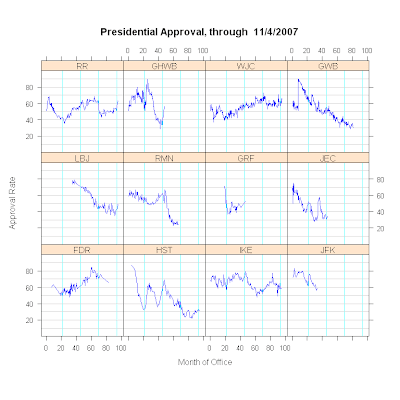
    If you follow politics for long enough, you may notice that coverage of presidential approval suffers from a bizarre ahistoricism. Reporters typically have almost no understanding of the forces that drive presidential approval or the patterns it tends to follow during the course of a president’s time in office.

    That’s why it’s amusing to see so many people acting like it’s news that approval of President Obama’s handling of health care and overall job performance numbers are trending downward (particularly among independents and Republicans). Of course his numbers are going down! It’s been a virtual certainty that this transition would take place since the day Obama took office. The only question was when it would happen and how far down they would go.

    The reason is simple. Presidential approval tends to decline after the honeymoon period as the opposition party begins to be more critical of the president. These messages remind opposition party members and sympathetic independents why they dislike the president. As a result, his approval numbers go down. This decline was likely to be especially significant in Obama’s case because his initial Gallup approval levels were the highest for any president since JFK.*

    The same reasoning applies to approval of Obama’s handling of health care, which has also declined. At first, Obama benefitted from what the political scientist John Zaller calls a one-message environment in which Congressional Republicans offered platitudes about their desire to work with him on health care. However, as the legislative process has moved forward, the GOP and its allies in the press have begun to aggressively attack his approach to the issue. As such, Republicans and sympathetic independents in the electorate are now more likely to tell pollsters that they don’t approve of Obama’s handling of the issue.

    The upside for Obama is that these numbers don’t seem to indicate anything specific about the prospects for his health care plan. It would be surprising if the public didn’t start to split along partisan lines at this point given the nature of the proposal. There isn’t much information here that the two parties couldn’t have anticipated (though it would be helpful to put the numbers in context — how do Obama’s health care approval numbers compare to, say, Clinton’s in July 1993?)

    The downside, however, is that Obama’s plan to rally the public to support health care reform in the coming weeks is unlikely to change these numbers, as Mickey Kaus reminds us:

    When was the last time a President’s campaign style attempt to sell a policy has actually succeeded in selling the policy? I can’t remember it. I can remember lots of flops (e.g.,Bush on Social Security). Traditional trips to non-Beltway places like Cleveland get heavily filtered by the media, for example. Prime time news conferences don’t get huge ratings, right?

    In general, political scientists have found that presidential efforts to change public opinion on domestic policy initiatives are rarely successful. The combination of the media filter and the offsetting effects of opposition messages tends to neutralize White House sales campaigns.

    In a highly polarized era, opinion on the president and his policy proposals is likely to be, well, highly polarized. Again, there’s not a lot of news here. The media should instead be focusing on the Senate, which is where the fate of health care legislation will be decided.

    * In an article for National Journal, Mark Blumenthal attributes the timing of the decline to the state of the economy. He may be right — there’s no doubt that economic perceptions influence approval. But it’s hard to isolate one factor as the cause of Obama’s decline in approval with such a limited amount of data.

    Update 7/21 12:34 PM: The other reason it shouldn’t be surprising that Obama’s numbers are declining is that the aggregate preference of the electorate for more or less government — what the political scientist James Stimson calls public mood — tends to move in the opposite direction of a dominant governing party. His current plot of mood data for 1952-2008 illustrates the point:

    Mood5208

    As such, we should expect the public to move in a conservative direction over the next few years.

    Update 7/21 2:14 PM: More ahistoricism from Drudge, who is claiming it’s a “danger sign” that Obama’s approval levels are less than Carter’s were at this point in his presidency:

    Drudgepoll

    In fact, however, Carter was quite popular in the first year of his presidency — more popular, in fact, than George W. Bush pre-9/11. I’m pretty sure Drudge didn’t see that as a “danger sign” for Bush at the time.

    (PS From a graphical perspective, note also how Drudge’s extremely narrow graphic exaggerates the negative slope of Obama’s approval trajectory.)

    Update 7/21 3:48 PM: For more on Obama’s declining health care approval numbers, see this new post from Gallup, which finds that more people disapprove of Obama (50%) on the issue than approve (44%). By contrast, the Post poll linked above finds 49% approve of how Obama has handled health care and 44% disapprove.

  • Post & WSJ repeat bogus “hiring tax” claim

    Just like in 1993-1994, the prospect of health care reform has unleashed a wave of misleading claims and bad reporting.

    The latest example is the suggestion that a proposal to levy a tax on employers who don’t provide health care for their employeees would hinder the economic recovery, which was recently made by GMU’s Brian Caplan. But as Kevin Drum pointed out, the provision wouldn’t go into effect until 2013 (see pp. 179-188 of the House bill PDF) — long after the recession is likely to be over.

    Unfortunately, the meme is likely to continue to circulate. Here’s the New York Post making an identical claim in an editorial Thursday:

    Having abandoned any notion of lightening the load with spending cuts, House Democrats have put forward a 1,000-plus-page proposal dripping with new taxes, surcharges and fees.

    The biggest losers? Small businesses — companies with as few as five employees, who’ll have to pay a penalty of up to 8 percent of income unless they provide their workers with health insurance.

    Now, these are the same businesses the administration thinks will hire workers laid off during the recession. But why would they do that if Washington effectively imposes a hiring tax?

    And here’s the Wall Street Journal repeating the claim in an editorial today:

    Unemployment is at 9.5% and rising, but Democrats will nonetheless impose a new eight percentage point payroll tax on employers who don’t provide health insurance for employees. This is on top of the current 15% payroll tax, and in addition to a new 2.5-percentage point tax on individuals who don’t buy health insurance. This means that any employer with more than $400,000 in payroll would have to pay at least 25% above the salary to hire someone.

    Note how both the Post and the WSJ suggest that the tax would take effect immediately (and therefore prolong the recession) without ever making the claim directly. In this way, they can maintain plausible deniability while still misleading the vast majority of their readers.

  • Goldblum corrects Goldblum death rumor

    Here’s one strategy that is likely to be effective at correcting a misperception about current events:

    The Colbert Report Mon – Thurs 11:30pm / 10:30c
    Jeff Goldblum Will Be Missed
    www.colbertnation.com
    Colbert Report Full Episodes Political Humor Jeff Goldblum
  • Politico reporters can read minds!

    Politico has made quite a splash since it was founded in 2007, in part because of a relentless focus on creating buzzworthy stories. Its pursuit of that goal has often resulted in coverage that pushes various pathologies of the political media to a new level. At this point, no publication can match Politico’s hyper-focused coverage of politics and process, minute-by-minute accounts of the news cycle, and personality-driven coverage of politicians.

    One especially disturbing example of the way Politico has supercharged news media pathologies is its formalization of the all-too-common practice of faux journalistic mind-reading. As I’ve shown over and over again, reporters and pundits frequently make claims about politicians’ inner thoughts that can’t possibly be verified in order to create dramatic narratives. But these claims are usually made without quotation marks. Politico has now started to write whole articles centered on fake inner monologues attributed to politicians.

    Back in March, I pointed out that Politico editor John F. Harris and reporter Jonathan Martin had written an article titled “What Obama said and what he meant” that purported to provide a “translation” of the President’s statements at a press conference.

    Then a couple of weeks ago, Politico’s Carrie Budoff Brown wrote a similar piece titled “Reading Barack Obama’s mind on health care” (via TPM). In it, she writes that she did “a little imaginary spelunking in the caves of the presidential mind and came up with this take on what Obama might really be thinking when it comes to health care.” In other words, she made it up.

    If this is the new model for political journalism, we’re in trouble.

  • More on how TPM has moved downmarket

    A few weeks ago, I commented on the move downmarket by Josh Marshall’s Talking Points Memo, a formerly excellent blog* that increasingly panders to its liberal audience with outrageous language, faux mind-reading, unsupported factual claims, and salacious details of conservative scandals.

    The example I focused on was the wall-to-wall coverage of John Ensign’s affair, including (bizarrely) a slideshow of the house owned by Ensign’s staffers. Since then, the pattern of over-the-top Ensign coverage has continued, culminating in a post by TPM founder Josh Marshall pondering the relative emasculation of Ensign and his accuser:

    There’s a lot of salacious back and forth today about the Ensign scandal. But beneath the tabloid headlines there’s a critical question that needs to be asked:

    Which is more emasculating? Getting paid a hundred grand by the guy who screwed your wife? Or being a fifty-something United States senator and still needing mom and dad to cut the check to pay off your mistress and her husband?

    Truly, no one but a media economist could have predicted back in 2000 or 2001 that Josh Marshall — a wonky political journalist with graduate training in history — would be writing posts about how “emasculating” it is for someone be “paid a hundred grand by the guy who screwed your wife.” There’s no better illustration of the power of commercial incentives to shape media content.

    *At times, TPM is still an excellent news source, but the substantive blogging on which it made its reputation is now the exception rather than the rule. Most of the time I’d characterize its content as something akin to talk radio for liberals.

    (Disclosure: In 2000, I worked on the campaign of Ensign’s opponent, Ed Bernstein.)