Brendan Nyhan

  • Fighting the mythical global currency

    Rep. Michelle Bachmann (R-MN) is hyping the myth that the Obama administration is planning to replace the dollar with a global currency. In fact, the proposal under discussion (which the Obama administration does not support) would create a new global reserve currency — it would not replace the dollar as the legal currency here in the US.

    Bachmann has even proposed a constitutional amendment that would prevent the president from entering “into a treaty or other international agreement that would provide for the United States to adopt as legal tender in the United States a currency issued by an entity other than the United States” As TPM DC’s Eric Kleefeld points out, it has a disturbing number of cosponsors (currently 32). Are these members — who are all Republicans — aware that no one is proposing creating a new currency that would serve as legal tender in the United States? I suspected that they might be pandering to ill-informed constituents but education, income, etc. are not closely related to cosponsorship — the only consistent predictor is the conservatism of the legislator’s previous voting record.

    Bachmann’s straw man legislation inspired me to check out another well-known myth — the fictitious “NAFTA superhighway” that was hyped by Ron Paul and talk radio hosts. And in fact former Rep. Virgil Goode (R-VA) introduced a resolution in 2007 expressing the sense of Congress that “the United States should not engage in the construction of a North American Free Trade Agreement (NAFTA) Superhighway System or enter into a North American Union with Mexico and Canada.” That bill attracted 52 cosponsors, including eight Democrats. With the exception of Marty Kaptur, a free trade opponent from Ohio, all of the Democrats — including Kirsten Gillibrand, the newly appointed senator from New York (!) — represented heavily rural districts that John Kerry lost in 2004. Supporters of the resolution tended to be more conservative and anti-trade.

    When we combine the cosponsorship lists on these bills, we get what I call the Congressional myth caucus — the fourteen members who sponsored or cosponsored both Bachmann’s amendment and Goode’s resolution:

    Michelle Bachmann (R-MN)
    Spencer Bachus (R-AL)
    Roscoe Bartlett (R-MD)
    Paul Broun (R-GA)
    Mary Fallin (R-OK)
    Virginia Foxx (R-NC)
    Trent Franks (R-AZ)
    Phil Gingrey (R-GA)
    Darrell Issa (R-CA)
    Walter Jones (R-NC)
    Kenny Marchant (R-TX)
    Thaddeus McCotter (R-MI)

    Ron Paul (R-TX)
    Zach Wamp (R-TN)

    It’s a brilliant approach to politics — you scare people with a phony rumor, take a stand against a position no one supports, and then claim credit for its defeat.

    Update 5/6 12:12 PM: The list above has been corrected to fix a coding error.

  • Privacy policy

    Third Party Advertiser Cookies and
    Web Beacons

    This web site participates in Six
    Apart Media, a comprehensive advertising program provided by Six Apart Ltd. for
    publishers all across the Web. 
    This section of our privacy policy describes how Six Apart Ltd. and the
    third party advertising networks and advertisers that display advertisements
    through Six Apart Media (collectively, “Advertisers”) collect, use, store and
    disclose data from visitors to this Web site.

    A “cookie” is a small amount of
    data, which often includes an anonymous unique identifier that is sent to your
    browser from a Web site’s computers and stored on your computer’s hard
    drive.  Cookies can be used to
    target advertisements relevant to your interests, based on your visits to
    different Web sites, to provide traffic measurement and other analytics and to
    conduct research. 

    A “Web beacon” is an electronic
    file on a Web page that allows a Web site to count users who have visited that
    page, to access certain cookies and to provide auditing, research and reporting
    for advertisers. 

    When your browser requests a page
    that displays advertising from one of the Advertisers, the Advertiser may view,
    edit or set its own cookie through your browser.  In addition, the Advertiser may place its own Web beacon in
    the page, which may be triggered by your browser’s request.

    Advertiser Privacy Policies

    If you would like to contact the Advertisers
    to learn more about their privacy policies and what options (if any) they offer
    to opt out of their data collection and use, please follow these links to their
    Web sites:

    Six Apart Ltd. 
    http://www.sixapart.com/privacy

    Six Apart Media third party
    advertising networks and advertisers
    http://www.sixapart.com/advertising/solutions-for-bloggers/privacy/3rd-party-list/index.html

    Some of these third party
    advertising networks are participants in the Network Advertising Initiative
    (“NAI”), a cooperative of online marketing and analytics companies committed to
    building consumer awareness and establishing responsible business and data
    management practices and standards. 
    You can learn more about NAI and how you may "opt out" of
    targeted advertising delivered by NAI member ad networks here. http://www.networkadvertising.org

  • David Horowitz is making sense

    It’s time for some serious man-bites-dog news from the punditocracy. Conservative gadfly David Horowitz — yes, that David Horowitz — is denouncing the excesses of anti-Obama rhetoric from the right:

    I have been watching an interesting phenomenon on the Right, which is beginning to cause me concern. I am referring to the over-the-top hysteria in response to the first months in office of our new president, which distinctly reminds me of the “Bush Is Hitler” crowd on the Left.

    Speaking of this crowd, have you seen any “I am so sorry” postings from that quarter as Obama continues and even escalates the former president’s war policy in Afghanistan and attempts to consolidate his military occupation of Iraq?

    Conservatives, please. Let’s not duplicate the manias of the Left as we figure out how to deal with Mr. Obama. He is not exactly the anti-Christ, although a disturbing number of people on the Right are convinced he is.

    I have recently received commentaries that claim that “Obama’s speeches are unlike any political speech we have heard in American history” and “never has a politician in this land had such a quasi-religious impact on so many people” and “Obama is a narcissist,” which leads the author to then compare Obama to David Koresh, Charles Manson, Stalin and Saddam Hussein. Excuse me while I blow my nose.

    This fellow has failed to notice that all politicians are narcissists – and that a recent American president was a world-class exponent of the imperial me. So what? Political egos are one of the reasons the Founders put checks and balances on executive power. As for serial lying, is there a politician that cannot be accused of that? And once, the same recent president set a pretty a high bar in this category, and we survived it. As for Obama’s speeches, they are hardly in the Huey Long, Louie Farrakhan, Fidel Castro vein. They are in fact eloquently and cleverly centrist and sober.

    So what’s the panic? It is true that Obama has shown surprising ineptitude in his first months in office, but he’s not a zero with no accomplishments as many conservatives seem to think – unless you regard beating the Clinton machine and winning the presidency as nothing. But in doing this you fall into the “Bush-is-an-idiot” bag of liberal miasmas.

    It’s either cause for celebration or a sign of the apocalypse that Horowitz thinks Obama haters have gone too far. This is the man who created a website that purports to link mainstream Democrats to terrorists and anti-American dictators and who published an article written by an employee encouraging censorship of dissent after 9/11. Let’s just say he’s not known for rhetorical restraint.

    With that said, it’s striking that Horowitz is virtually the only public figure acknowledging this inconsistency. After eight years of condemning the fevered claims of obscure Bush-hating leftists, prominent conservatives like Sean Hannity and Rush Limbaugh are making equally absurd claims (Obama as a closet Marxist who secretly hopes to gain control of the means of production, etc.). It’s the converse of the almost overnight transition that Limbaugh and Hannity et al. made between crazed Clinton-hating (through early 2001) and claiming no one should criticize the president (post-9/11). Apparently cognitive dissonance is no match for ideology.

    PS “Excuse me while I blow my nose” is my nominee for non sequitur of the year. What does that mean?

  • Kantor’s Democratic “deficit hawk” snark

    Jodi Kantor’s New York Times profile of Obama OMB director Peter Orszag includes this bit of unjustified snark:

    A former director of the Congressional Budget Office, Mr. Orszag is what passes in the Democratic Party for a deficit hawk.

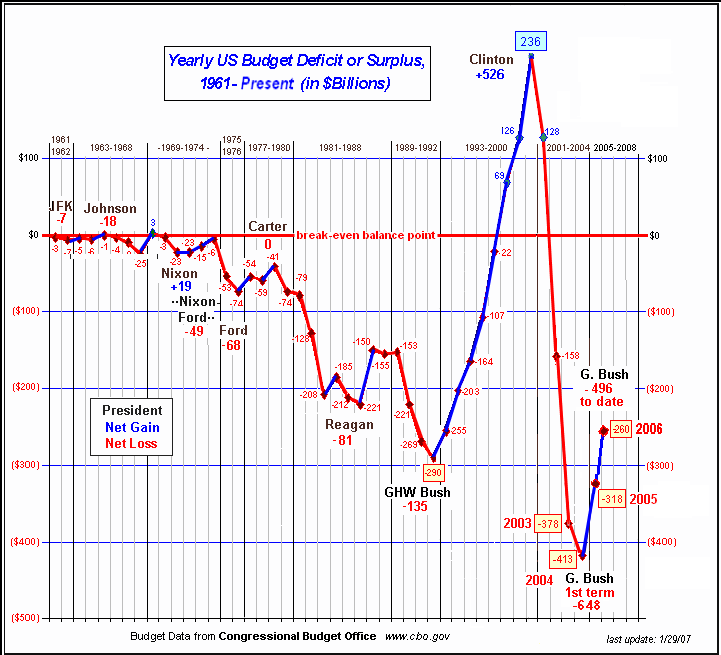
    “[W]hat passes in the Democratic Party for a deficit hawk”? Is Kantor aware of the fiscal policy record of Democratic and Republican presidents in the United States over the last 28 years? It’s not particularly favorable to the idea of Republicans as deficit hawks:
    Deficit

    For her next story, I would encourage Kantor to seek out all the true deficit hawks in the GOP. I’m sure absolutely none of them supported President Bush’s massive deficit-enhancing tax cuts.

  • Obama press conference theater criticism

    I skipped the Obama press conference Tuesday night (I was celebrating after my dissertation defense — hooray!) but I’m horrified by a couple of the articles I saw on it yesterday.

    First, the New York Times ran an especially stupid analysis by Peter Baker and Adam Nagourney that recycled the “wooden professor” trope that the media applied so frequently to Al Gore:

    [I]t was Barack Obama the lecturer, a familiar character from early in the campaign. Placid and unsmiling, he was the professor in chief, offering familiar arguments in long paragraphs — often introduced with the phrase, “as I said before” — sounding like the teacher speaking in the stillness of a classroom where students are restlessly waiting for the ring of the bell….

    The top-to-bottom stupidity of this paragraph is breathtaking. First, Baker and Nagourney make up a “familiar character” called “Barack Obama the lecturer” — an almost explicit acknowledgment of the way the media likes to construct multiple personas for politicians and play them off against each other in made-up psychodramas. (It’s reminiscent of Mark Leibovich’s invention of Hillary Clinton “Version 08, Nurturing Warrior, Presidential Candidate Model.”) Baker and Nagourney then proceed to criticize Obama based on subjective interpretations of his tone and demeanor — namely, the idea that he was “unsmiling” and sounded like a “lecturer” or “professor” whose students are “restlessly waiting for the ring of the bell.” And does anyone doubt that all the opposite criticisms would have been applied had Obama behaved differently? (For instance, when he made a joke during a 60 Minutes interview, Steve Kroft asked him if he was “punch-drunk.”)

    The worst part of the article, however, reinforces the media pattern of berating Obama for not seeming mad enough at A.I.G.:

    At a time of anger and anxiety in the country, Mr. Obama showed little emotion. He rarely cracked a joke or raised his voice. Even when he declared himself upset over the $165 million in bonuses paid this month by the American International Group despite its taxpayer bailout, his voice sounded calm and unbothered…

    To a certain extent, Mr. Obama’s demeanor could have been calculated — an effort, aides said, to lower the temperature after a supercharged week and nudge the country toward what Mr. Obama considers the more pressing issues of fixing the banking system and reviving the economy. Even after excoriating the A.I.G. executives, he cautioned that “the rest of us can’t afford to demonize every investor or entrepreneur who seeks to make a profit.”

    The only time he seemed irritated came when he was asked why the attorney general of New York, Andrew M. Cuomo, seemed to have more success getting A.I.G. executives to return some bonuses than his own administration. Pressed on why he did not express outrage immediately upon learning of the bonuses, Mr. Obama said sharply, “Well, it took us a couple of days because I like to know what I’m talking about before I speak”…

    What would satisfy these reporters? Should Obama stomp around and pound the podium? Hold his breath until he turns blue? It’s not clear what emoting on command would accomplish, but faulting Obama for failing to do so is an easy kind of theater criticism that allows journalists to use a critical voice without being subject to accusations of bias.

    The worst article, however, came from John F. Harris and Jonathan Martin at Politico, who take journalistic mind-reading to a new level with an article that offered a series of “translations” of “what [Obama] meant” in making various statements during the press conference:

    What he said: “Now, we never expected, when we printed out our budget, that [Congress] would simply Xerox it and vote on it….The bottom line is—is that I want to see health care, energy, education and serious efforts to reduce our budget deficit.”

    What he meant: Chill out. I’m just not going to get all worked up about the fact that Kent Conrad and some other moderate Democrats are upset about the cost of my plans. If they want to tinker, go ahead. But you watch—I’ll get nearly everything I want…

    What he said: “At the end of the day, the best way to bring our deficit down in the long run is not with a budget that continues the very same policies that have led us to narrow prosperity and massive debt. It’s with a budget that leads to broad economic growth by moving from an era of borrow-and-spend to one where we save and invest.”

    What he meant: There is no way I am going to lose the language wars in a budget battle. My budget may borrow more and spend more than any in history. But I am going to frame this plan with appeals that emphasize sobriety and responsibility. That may be a bit brazen, but no more so than Republicans who rubber-stamped huge deficits under Bush…

    What he said: “A budget is a snapshot of what we can get done right now, understanding that eight, 10 years from now we will have a whole series of new budgets.”

    What he meant: Give me a break. As Keynes said, in the long run we are all dead…

    What he said: “You know, there was a lot of outrage and finger-pointing last week, and much of it is understandable….At the same time, the rest of us can’t afford to demonize every investor or entrepreneur who seeks to make a profit. That drive is what has always fueled our prosperity, and it is what will ultimately get these banks lending and our economy moving once more.”

    What he meant: Put the pitchforks down, folks. AIG outrage is last week’s story. This week’s story is my plan to use generous federal subsidies to convince investors to clean up the banks by buying their toxic assets. The plan won’t fly if I am seen as anti-capitalist.

    He returned to the issue when CNN’s Ed Henry pressed him on why if he was so mad about AIG bonuses, he waited days to express his outrage, and why he’s letting New York Attorney General Andrew Cuomo hog the spotlight on the issue.

    “It took us a couple of days because I like to know what I’m talking about before I speak,” Obama said.

    Translation: Put a sock in it, Ed…

    What he said: “It’s not going to cripple them. They’ll still be well-to-do. And, you know, ultimately, if we’re going to tackle the serious problems that we’ve got, then, in some cases, those who are more fortunate are going to have to pay a little bit more.”

    What he meant: Suck it up, rich folks, and welcome to your post-Bush tax code.

    What he said: “With respect to the American people, I think folks are sacrificing left and right. I mean, you’ve got a lot of parents who are cutting back on everything to make sure that their kids can still go to college. You’ve got workers who are deciding to cut an entire day — an entire day’s worth of pay so that their fellow co-workers aren’t laid off.”

    What he meant: I know that Washington reporters and think-tank experts think all politicians are weak and irresponsible unless they are cutting entitlements or asking the middle-class to suffer. Well, I know a political trap when I see one.

    What he said: “How effective these negotiations may be, I think we’re going to have to wait and see. But, you know, we were here for Saint Patrick’s Day, and you’ll recall that we had what had been previously sworn enemies celebrating here in this very room; you know, leaders from the two sides in Northern Ireland that, you know, a couple of decades ago or even a decade ago people would have said could never achieve peace.”

    What he meant: Please refer all non-emergency foreign policy questions to Secretary of State Clinton – and in the meantime please accept this heartwarming story as down payment on an Israel policy.

    What he said: “Kevin Baron, Stars and Stripes. Is Kevin here? There you go.”

    What he meant: You have to admit, I am clever. I get to call on a reporter who is not from one of the big news organizations, whose subject is going to be easy to predict, and whose question I can answer by pointing out that I want to improve health care for veterans.

    With skills like these, Harris and Martin are in the wrong profession. Allow me to offer a humble suggestion:
    Harrismartin

    From a broader perspective, this is an especially disturbing innovation for novelistic political journalism. Rather than just pretending to know the motives and beliefs of public figures, the Harris/Martin “translation” format allows reporters to quote directly from politicians’ minds. In this format, journalists can ascribe whatever intent or motive to public figures that they want without ever being proven wrong. No wonder people think Politico is such an innovative publication!
  • An old favorite: Kass on cones

    An Instapundit link reminds me of one of my all-time favorite posts, which details the objections of Leon Kass (the former chair of President Bush’s bioethics council) to eating ice cream cones in public. Yes, ice cream cones. If you haven’t read the post yet, it’s a treat!

  • Reuters pushes GOP spin on Obama’s goals

    Drudge is linking to a Reuters analysis that illustrates how partisan spin can harden into conventional wisdom.

    The article, which was written by Tabassum Zakaria, claims that (as the headline puts it) “Resistance grows to Obama’s bigger government.” At one point, after discussing the absurd claims that Obama is a socialist, Zakaria offers the following characterization, which implicitly reinforces the negative framing of Obama:

    Obama came to power on a wave of popular support with a strong record as a social liberal in the U.S. Senate. One of his goals is to redistribute some of the country’s wealth, which appeals to those who say they want action to counter a growing gap between the rich and poor.

    The language used (“his goals”) suggests that Obama has openly called for redistribution. As far as I know, however, the sole evidence for that claim is limited to the GOP’s interpretation of Obama’s “spread the wealth around” comment, as Reuters itself acknowledged in its reporting back in October:

    The tax question prompted Obama to say he wanted to “spread the wealth around,” a comment that McCain and Republicans have jumped on as a sign that the Democrat would pursue income redistribution policies if elected.

    In addition, a transcript of Obama’s conversation with “Joe the Plumber” shows that the meaning of the phrase “spread the wealth around” is relatively ambiguous:

    Joe: It seems like you’d be welcome to a flat tax then.

    Obama: You know, I would be open to it except for … here’s the problem with the flat tax. If you actually put a flat tax together, you’d probably … in order for it to work and replace all the revenue that we’ve got, you’d probably end up having to make it like about a 40 percent sales tax. I mean, the value added, making it up. Now, some people say 23 or 25, but, in truth, when you add up all the revenue that would need to be raised, you’d have to slap on a whole bunch of sales taxes on it. And I do believe that for folks like me who are, you know, have worked hard but, frankly, also been lucky, I don’t mind paying just a little bit more than the waitress who I just met over there, who’s … things are slow and she can barely make the rent. Because my attitude is that if the economy’s good for folks from the bottom up, it’s gonna be good for everybody. If you’ve got a plumbing business, you’re gonna be better off if you’ve got a whole bunch of customers who can afford to hire you. And right now, everybody’s so pinched that business is bad for everybody. And I think when you spread the wealth around, it’s good for everybody.

    There’s just not enough evidence to support the Reuters language as an objective characterization of Obama’s goals in office.

  • Nyhan world HQ on the move (twice)

    For those who are interested in my future plans, the latest news is that I’ll be starting a two-year postdoc in the fall as a a Robert Wood Johnson Scholar in Health Policy Research at the University of Michigan (see the program’s announcement of the incoming cohort). After that, I’ll be joining the Department of Government at Dartmouth College as an assistant professor. I’m thrilled about both positions.

  • Thomas Friedman’s unity fantasy on banking

    Thomas Friedman’s proposed solution to the banking crisis reads like a parody of high Broderism:

    Which is why I wake up every morning hoping to read this story: “President Obama announced today that he had invited the country’s 20 leading bankers, 20 leading industrialists, 20 top market economists and the Democratic and Republican leaders in the House and Senate to join him and his team at Camp David. ‘We will not come down from the mountain until we have forged a common, transparent strategy for getting us out of this banking crisis,’ the president said, as he boarded his helicopter.”

    I will never understand why so many establishment pundits believe that all problems have a bipartisan solution. From a practical perspective, it’s not clear that a banking policy exists that “20 leading bankers, 20 leading industrialists, 20 top market economists and the Democratic and Republican leaders in the House and Senate” would unanimously prefer to the status quo. More importantly, why would we assume that such a policy is best? There’s no reason (beyond wishful thinking) to imagine that bipartisan compromises are always optimal, particularly on technical issues like banking policy. Sometimes one side is right and the other side is wrong.

  • David Brooks reads minds on vouchers

    In yet another example of a pundit projecting nefarious motives onto his opponents, David Brooks claims in his column today that “[t]he idea was to cause maximum suffering” when Democrats ended a school voucher experiment in Washington, DC:

    Democrats in Congress just killed an experiment that gives 1,700 poor Washington kids school vouchers. They even refused to grandfather in the kids already in the program, so those children will be ripped away from their mentors and friends. The idea was to cause maximum suffering, and 58 Senators voted for it.

    Whose idea? Can Brooks provide any evidence that any member of Congress intended to cause “maximum suffering” for children in the program?

    Brooks is pulling a classic pundit trick where you claim that your opponent wants the worst possible outcome of a policy decision. For instance, back in 2007, Eric Alterman interpreted George W. Bush’s health care policies as evidence that Bush has a “preference for allowing poor kids to get sick and die” and that he “wants children to get sick and die.” Like Brooks, Alterman had no evidence that Bush actually held those preferences or motives (as he eventually conceded), but it didn’t stop him from engaging in the smear.